• Thank you to Carol and Steve Bowman, the forum owners, for our new upgrade!

Sayyida Manoubia , a Sufi female saint of Tunisia whose shrine is frequented by women only

Ajay0

Senior Member
Sayyida Manoubia is a Sufi female saint of Tunisia whose shrine is frequented by women alone.
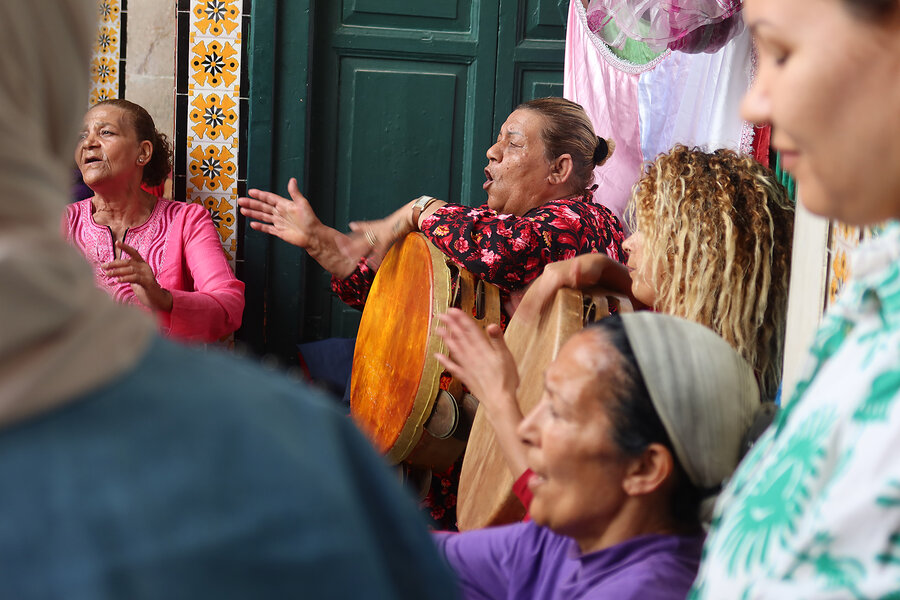

While other Sufi shrines across North Africa are frequented by groups of men chanting the names of God and praying, the scene at Sayyida Manoubia is almost exclusively an all-women affair.

Every Sunday thousands of women from across Tunisia walk through an hourglass-shaped wooden door into the shrine, tucked away on a side street near Razi Hospital in the Tunis suburb of Manouba.

Upon entering, visitors are embraced by a festival of prayer and womanhood.

Today Sayyida Manoubia is a patron saint both to the devout and to Tunisian feminists who see her as a revolutionary who pursued higher education and religious authority at a time when such opportunities for women were restricted.

Devoted to good works, prayer, and the study of Islam, Sayyida Manoubia, it is said, refused dozens of offers of marriage, concerned that a domestic life would interfere with her charitable work and pursuit of heavenly truths. She died at the age of 76, never having married.
 
Chargpt:

Clear answer:
There is no evidence at all — neither in the medieval manāqib of Sayyida al-Manoubiyya, nor in modern Tunisian or scholarly accounts — that she believed in reincarnation.

Any mention of reincarnation in connection with her comes only from modern online speculation by outsiders, not from her words, teachings, or her traditional cult.

So: she is not associated with reincarnational beliefs in any reliable source.
 
Mainstream Islam:
  • Orthodox Sunni and Shiʿi theology reject tanasukh (transmigration of souls, i.e., reincarnation).
  • Core doctrine: one earthly life, followed by death, barzakh (intermediate state), resurrection, and judgment.
Among Muslims in general:
  • Historically, reincarnation has been considered heretical. Classical theologians (e.g., al-Ghazālī, Ibn Taymiyya) explicitly attacked tanasukh as contradictory to Qurʾān and hadith.
  • Still, some marginal sects and heterodox groups incorporated reincarnation ideas:
    • Druze (an Ismaʿili offshoot, Lebanon/Syria): believe in the transmigration of souls until spiritual perfection.
    • Alawites (Syria): traditional belief in tanasukh.
    • Certain ghulāt Shiʿi sects (extremist/heterodox Shiʿa in early centuries) entertained reincarnation or soul migration.
In Sufism specifically:
  • Mainstream Sufi orders (Qadiriyya, Naqshbandiyya, Shādhiliyya, Chishtiyya, etc.) reject reincarnation.
  • Sufi cosmology emphasizes cycles of death and rebirth in the mystical sense (ego-death, annihilation in God / fanāʾ, subsistence in God / baqāʾ). This is metaphorical, not literal.
  • A few heterodox Sufi-influenced thinkers, especially in Persian and Indian contexts, flirted with reincarnation ideas, sometimes borrowing from Hindu or Neoplatonic thought. Examples:
    • Ibn ʿArabī used language of cycles of being and repeated embodiment, though usually interpreted metaphorically.
    • Some Indian Sufi poets in a Hindu-influenced environment hinted at transmigration imagery, though rarely outright doctrinal.
Summary:
  • Orthodoxy (both Islam and Sufism proper): reincarnation is denied.
  • Heterodox sects (Druze, Alawites, ghulāt Shiʿa): affirm it.
  • Mystical literature (some Sufis, especially in India/Persia): may use reincarnation-like imagery, but usually symbolic rather than doctrine.
 
Hi Ajay0,

She sounds like a very virtuous lady. But, outside of that, no signs of reincarnation here. We recently had some discussions of the Druze, who do believe in reincarnation (and I find interesting). Could you perhaps provide some additional information on the reincarnation beliefs of the Alawites and ghulat Shia?

Cordially,
S&S
 
I consider the Sufis and the Ahmediyas as the most liberal and peaceful branches of Islam.

The sufis emphasize music, poetry and dancing a lot. Generally speaking, reincarnation is not a belief in the sufi theological system.

But there are Sufis like Meher Baba, Shirdi Sai Baba, Inayat Khan , Jallalludin Rumi who are said to have belief in reincarnation.

There is a verse of Rumi which is said to describe his belief in reincarnation...


I died as a mineral and became a plant,
I died as a plant and rose to animal,
I died as animal and I was man,
Why should I fear?
When was I less by dying? ~ Rumi

Imo, it would be the Sufis and Ahmediyas other than the Shias who would be possibly accepting of belief in reincarnation or open to it.
 
Back
Top