• Thank you to Carol and Steve Bowman, the forum owners, for our new upgrade!

African belief in Reincarnation?

katrien

Senior Registered
Has much anthropological or other work been done on the african belief in reincarnation?

I was just reading this excerpt/translation from the 1920's on I think the Zulu or another Bantu group.

"We teach that he has a body; that within that body is a soul; and within the soul is a spark or portion of something we call Itongo, which the Common Man interprets as the Universal Spirit of the Tribe. We teach that after death the soul (Idhlozi) after hovering for a space near the body departs to a place called Esilweni (Place of the Beasts). This is a very different thing...from entering the body of a beast. In Esilweni, the soul assumes a shape, part beast and part human. This is its true shape, for man's nature is very like that of the beast, save for that spark of something higher....For a period which is long or short, according to the strength of the animal nature, the soul remains in Esilweni, but at last it throws aside its beast-like shape and moves onward to a place of rest. There it sleeps till a time comes when it dreams that something to do or to learn awaits it on earth; then it awakes and returns, through the Place of Beasts, to earth and is born again as a child. Again and again does the soul travel through the body, through the Place of Beasts and returns to the body"

"we know that the Itongo is not the mere Spirit of the Tribe, but is the Spirit within and above all men -- even all things"
 
Hi Katrien.


Very interesting and great question. This is the first I remember reading about it. Thanks for bringing it up.


Tinkerman
 
Thanks for this information. I wasn't aware of much research on African beliefs. Unfortunately, most of African culture and religion has been lost. Unlike some other areas of the world, ancients left few monuments or remnants of their civilization that would help us learn about them. Within the last few hundred years, much of Africa has been destroyed by invaders.


Memories of Africa through reincarnation would be interesting to explore, but difficult to verify. I found your translation of this tribal belief very interesting.
 
Thanks, Katrien - that was interesting! :thumbsup:


I have earlier taken some courses in African Studies, and remember Itongo, but most beliefs I remember from those courses were connected to ancestral spirits (I wasn't especially interested in reincarnation at the time).


Then again Africa is such a vast continent with different traditions and belief systems.


Karoliina
 
traveler said:
Unfortunately, most of African culture and religion has been lost. Unlike some other areas of the world, ancients left few monuments or remnants of their civilization that would help us learn about them..
There is actually alot of information available on Ancient africa and its material culture from the ancient nok/ Ife / Kwatakwashi / Bura / Katsina / Sokoto sculptures to nubian/benin/zanzibar/Ife cultures etc,it's just not generally well known,rather like ancient eastern european culture - it's not of much interest to people. Same goes for it's traditional culture and religions many areas have not altered and ancient traditions reign.


I assure you African culture and religion has in no way been lost.
 
Karoliina said:
most beliefs I remember from those courses were connected to ancestral spirits (I wasn't especially interested in reincarnation at the time).
Yes definately the emphasis is far more on ancestry and reincarnation through ancestry.
 
Hi, I know several people from various countries in Africa, and several of them remember living previously. Nigeria, Cameroon, Burkina Faso....
 
Hi Katrien,


Here in Brazil, the African slaves brought their religion to the country and much of it still persists today, albeit "synchretized" with the Catholic religion. The Saints of Catholicism were associated to the African gods, mainly the gods of the Yoruban tribes from the Nigeria and Congo regions. And yes, as the Candomblé religion deals directly with spiritual entities, and reincarnation is a spiritual reality, they also hold the knowledge of the reality of reincarnation... :thumbsup:


In Candomblé (which has similar origins to the Vodun and Santeria of Central American countries), there are interesting similarities between its "gods" and the "gods" of the Egyptian and Greek mythologies. They hold the belief in one "Supreme God" - Olorun, or Olodumareh, or Allahbalasheh - and 16 "lesser gods", who nevertheless "rule" upon us. Here are some of them:


Oshallah - Jesus


Ogum - St. George


Yemanjah - St. Mary


Shango - St. Peter


Nanan - St. Anne (Jesus's grandmother)


Oshum - St. Mary of Conception


Yansan - St. Barbara


Obah - Joanne of Arc


Oshossi - St. Sebastian


Shapanan - St. Lazzarus


Esú - the "devil"
 
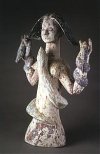
I have heard of oshun is she the same as oshum? interesting that they have aligned her with mother mary.I think she has some relation to mami wata - a water spirit,she is a described a similar way but mami wata is generally fair skinned."Black madonna" figures too always seem to me to have some alignment with early african maternal figures.

africa02L.jpg

/monthly_2007_12/africa02L.jpg.9f830ac080a0f6bb998cc95ce119edf1.jpg
 
Hi Katrien,


Yes, precisely, they are one and the same. Oshum or Oshun, if you like, is the Orisha of the sweet waters. The Orisha of the rivers. She is the daughter of Yemanja, the "Queen of the sea". She is "the bringer of gold and fortune". She is also the Orisha responsible for conception and for children up to the age of seven, after which Yemanjah takes over the responsibility for them. She is, in contrast with Yemanja, the "Negro Virgin Mary", associated to St Mary of Conception.


There is a beautiful story here in Brazil of some fisherman who were fishing in a river and were catching no fish. After a while, they found a part of a statue of the Virgin Mary in their net. Then the other part, and were susprised to find that the statue was of a negro Virgin Mary. Their nets began to be filled with fish. Miracles were associated to this statue, which is now the statue of the "patron saint" of Brazil - Nossa Senhora da Aparecida... :) :thumbsup:
 
Intersting,there are so many black "virgin marys" to be found,any search on the "black madonna" brings hundreds of them up.
 
This was very interesting


:thumbsup: I like to study a lot of different beleifs it's one of my passtimes, but i never found a link online for african beleifs about reincarnation, but I have read their creation myths. It's all very interesting!
 
Thank you for posting this thread.


For about the past three years I have been a member of a Catholic Church with a large Nigerian (Igbo) community. I have implied but never directly stated my own beliefs about reincarnation. Mostly they are conservative on theological grounds, and I did not want to alienate them. I increasingly realize that my beliefs have always been "syncretic" and that my impression that the Church could not accommodate them led me to leave it temporarily. I teach a Sunday School class and try to leave some things open ended. For instance, I tell the kids that God cares for each soul, as in not even a sparrow falls that God does not know about, and that God is all powerful and hence can do whatever is best for that soul. (implied--that includes sending it back.) I let them know I have a connection with ancestors. They resonate with that. Children who are fortunate enough to know their traditions occasionally share a little of their traditional beliefs, like the very young and very old are prone to dreams and visions.


I am happy to say my implications have not brought down ecclesiastical lightning bolts. Since I'm becoming more established in the church community perhaps I can be a little more direct in encouraging my friends to share and value their tradition, that it adds to, not rivals, Christian faith. I want to know more about it.
 
That's great that you have found a way to marry these ideas sneakily within the religious framework you have which isnt broad enough to carry them.


My mother is a very devout christian despite being of part damara [african tribe] ancestry and cringes whenever i bring up anything related to traditional african religion.I'm glad you are leaving space open for these ties to the past,dropping it to me is like losing your shadow.
 
Thanks :)


There is so much more to know.


I am really enjoying that site that you posted on another thread. The idea of "life-share," "personal ray" and "vital influence" to describe a concept with both commonalities and differences to reincarnation opens up new possibilities to investigate.


Personally, I can see that idea in two rather disturbing experiences I had involving my ancestor which I saw in third person, unlike most which seem fully shared. I could see him also having an existence as a separate entity.


The Catholic Church, for all its problems, is diverse and dynamic. The focus now is getting the West to accept any kind of authority and tradition at all, and too often ideas outside of traditional Western thought are viewed as the enemy of this task. I wish they would realize that it is the moral failure of the West that led to discrediting its traditions, and that merging and syncretizing with other traditions would LEGITIMIZE and STRENGTHEN rather than destroy the voice of religious institutions. Catholicism, with its international nature and varied manifestations, my be more able to accommodate these ideas than some Protestant forms of Christianity.


It is sad that your mom doesn't want to talk about her traditions.


I think our society has a big problem in that people value the wrong kinds of power and then value those ideas and cultural practices that belong to the "powerful" and are ashamed of those that belong to the "weak."


Your link's concern with the "language of accommodation" was a point well taken.
 
the ga belief in reincarnation.


Gblamo: The Ga believe in spiritual incarnation. Their word “gblamo” explains their sense of death. Gblamo means both ‘reincarnation’ and is also the name of a vine that twists around a post. Like a twisting vine, the dead circle around and around in a cycle of life, death and rebirth. Funerals are concrete expressions of their belief in life’s continuing cycle. During funerals, the dead are treated to as much luxury as the family can afford. In this way they give a proper send off to the spirit, guaranteeing its successful passage into the company of the Ga ancestors. For the Ga, it is better to incur lifelong debts than to cut back on funeral expenses.
 
Katrien said:
...For the Ga, it is better to incur lifelong debts than to cut back on funeral expenses.
They have that in common with the Ancient Egyptians don't they? :)


But then Egypt is part of Africa. All part of a very old set of beliefs no doubt.
 
Back
Top